
Titan, Saturn's largest moon, is the second largest moon of our solar system and larger than any other dwarf planet of our solar system. It has very dense atmosphere primarily composed of nitrogen. The upcoming Dragonfly mission to Titan (expected to be launched in June 2027) will provide valuable insights into the potential habitability of these extraterrestrial environments and the existence of life beyond Earth.
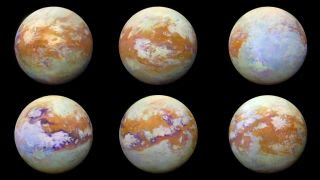 |
| Credit: NASA / JPL-Caltech |
Titan's Atmosphere and Hydrocarbon Cycle
Titan possesses a dense atmosphere primarily composed of nitrogen, with trace amounts of methane and other hydrocarbons. The presence of methane in its atmosphere plays a crucial role in Titan's hydrocarbon cycle, which bears similarities to Earth's water cycle. Methane on Titan undergoes processes such as evaporation, condensation, cloud formation, and precipitation, shaping the moon's dynamic weather patterns.
However, the geological formations on Titan are made of entirely different materials. Instead of water, it's liquid methane that flows through rivers, and instead of sand, it's hydrocarbons that blow into dunes.Liquid Methane Lakes
One of the most captivating discoveries on Titan is the presence of liquid methane lakes. The Cassini-Huygens mission, a joint effort by NASA and the European Space Agency, provided evidence of these lakes, particularly in the moon's polar regions. Radar and infrared observations revealed dark, smooth regions consistent with liquid surfaces. These lakes are composed of methane and ethane, which exist in a liquid state due to Titan's extremely low temperatures and high atmospheric pressure. The largest known lake, Kraken Mare, spans approximately 400,000 square kilometers.
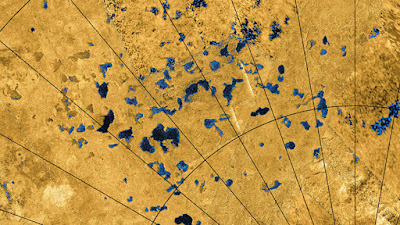
Credit: NASA / JPL-Caltech
Implications for Liquid Water
The presence of liquid methane lakes on Titan raises
intriguing questions about the possibility of liquid water beneath the moon's
surface. Scientists believe that a layer of water-ammonia mixture, called an
"ocean," may exist beneath Titan's icy crust. This subsurface ocean
could interact with the moon's rocky core and generate hydrothermal activity,
providing potential environments for life.
Evidence for Subsurface Water
Data from the Cassini mission has provided compelling evidence supporting the presence of a subsurface ocean on Titan. Gravity measurements suggest a global subsurface ocean layer, while analyses of Titan's shape and rotation indicate the presence of a subsurface layer that is more deformable than expected if it were composed solely of ice. Furthermore, the detection of ammonia in Titan's atmosphere adds credibility to the existence of a water-ammonia ocean beneath the moon's surface.
Astrobiological Significance (Potential For Life)
The presence of liquid water on Titan, whether in the form of subsurface oceans or hydrothermal activity, holds significant astrobiological implications. Water is a key ingredient for life as we know it, and the potential habitability of Titan's subsurface environments raises exciting possibilities for the existence of microbial life or prebiotic chemistry. Understanding Titan's liquid water is crucial for advancing our knowledge of the potential for life beyond Earth and expanding our understanding of habitable environments in our solar system and beyond.
Titan, Saturn's largest moon, with its liquid methane lakes and the possibility of subsurface liquid water,
remains a captivating world with astrobiological significance. Ongoing research
and future missions will continue to explore and unravel the mysteries of this
enigmatic moon, offering insights into the potential for habitability and the
origins of life in our solar system.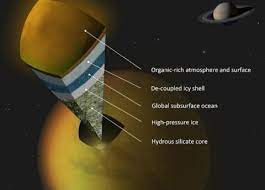
Credit: NASA