
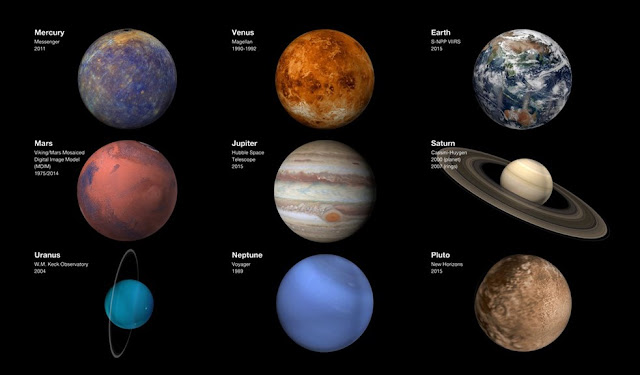
Our solar system is made up of several regions, including the inner planets (Mercury, Venus, Earth, and Mars), the asteroid belt, the outer planets (Jupiter, Saturn, Uranus, and Neptune), and the Kuiper belt and Oort cloud. The inner planets are closer to the sun and are primarily composed of rock and metal, while the outer planets are farther away and are primarily composed of gas and ice. The asteroid belt is located between Mars and Jupiter and is made up of small, rocky objects. The Kuiper belt and Oort cloud are located beyond Neptune and are made up of small, icy objects.
 |
| Image: NASA |
Conditions at Inner Region Planets:
Mercury:
Mercury is the closest planet to the sun and its surface can reach temperatures of up to 800 degrees Fahrenheit during the day, while the night side can drop to minus 290 degrees Fahrenheit. It has a very thin atmosphere, which is not thick enough to protect the planet from the sun's radiation or to retain heat. There is no liquid water on the surface of Mercury, which is essential for human survival. The surface of Mercury is constantly bombarded by solar radiation, which would be dangerous for humans.
Venus:
We cannot live on Venus because it has a thick, toxic atmosphere that is primarily composed of carbon dioxide, which would make it difficult to breathe. The surface temperature is also extremely hot, reaching up to 864 degrees Fahrenheit, which would make it uninhabitable for humans. Additionally, Venus has a crushing atmospheric pressure, with the surface pressure being about 90 times that of Earth's at sea level, which would also make it inhospitable for humans.
Mars:
Living on Mars is currently not possible for humans due to a number of reasons. The primary challenge is the planet's harsh environment. Mars has a thin atmosphere that does not provide enough protection from the sun's radiation, and the planet's surface is covered in dust and debris that can be dangerous to breathe. Additionally, the planet's average temperature is around -63 degrees Fahrenheit, which is much colder than Earth and would require special equipment to keep humans warm. Mars also has a very thin atmosphere, which would not provide enough air pressure for humans to breathe comfortably.
Another major challenge to living on Mars is the lack of resources. The planet has no liquid water on its surface, which is essential for human survival, and it would have to be transported from Earth. Additionally, Mars has no magnetic field to protect against solar radiation, which would pose a significant risk to human health.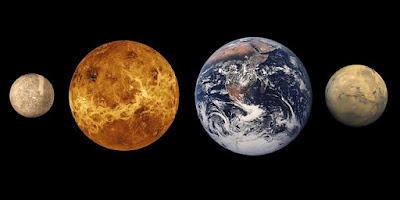 |
| Credit: Pixabay |
Conditions at Outer Region Planets:
Jupiter:
Saturn:
Uranus:
Neptune:
Conditions at Moon
Living on the
moon is currently not possible for humans because it does not have a suitable
environment to support human life. The moon has no atmosphere, which means it
has no air to breathe and no protection from the sun's radiation. It also has
extreme temperature variations, with temperatures reaching over 127 degrees
Celsius during the day and dropping to minus 173 degrees Celsius at night.
Additionally, the moon has no water, which is essential for human survival, and
the surface is covered in fine dust that can be dangerous to breathe.
However, with
current and future advancements in technology, scientists and engineers are
working on developing the means to establish a sustainable human presence on
the moon. This includes developing new technologies such as life support
systems, radiation protection, and lunar habitats that can withstand the harsh
lunar environment. The quest to establish a human settlement on the moon is
driven by scientific research, resource exploration and potential commercial use.