
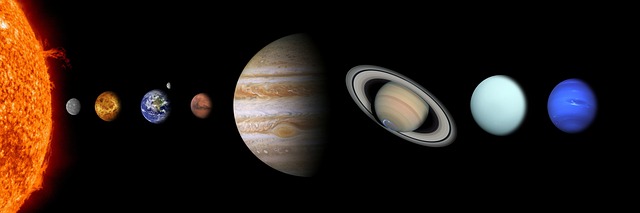
The solar system is the group of celestial objects that
orbit around the sun. It consists of the sun, the planets and their moons, and
other objects such as asteroids, comets, and dwarf planets. There are eight
planets in our solar system: Mercury, Venus, Earth, Mars, Jupiter, Saturn,
Uranus, and Neptune. The terrestrial planets (Mercury, Venus, Earth, and Mars)
are located near the sun and are relatively small and rocky. The outer planets
(Jupiter, Saturn, Uranus, and Neptune) are larger and made up of gases and
liquids. Pluto was originally classified as the ninth planet in the solar
system, but in 2006, it was reclassified as a "dwarf planet" by the
International Astronomical Union (IAU).
In addition to the
planets, the solar system also contains a vast number of small objects,
including asteroids, comets, and other minor planets. These objects are thought
to be leftovers from the formation of the solar system more than 4 billion
years ago. The solar system is located in the Milky Way galaxy.
 |
| credit: pixabay |
Theories about solar system formation
There are several theories about how the solar system
formed, but most scientists believe that it formed from a cloud of gas and dust
that surrounded the young sun. This cloud, known as the solar nebula, was
composed of hydrogen, helium, and other elements. As the sun formed and began
to spin, the centrifugal force caused the solar nebula to flatten into a
disk-shaped mass.
With the passage of time, the dust and gas in the solar
nebula began to coalesce and form clumps. These clumps eventually grew into
planetesimals, which were small, rocky bodies that ranged in size from a few
kilometers to a few hundred kilometers in diameter. As the planetesimals collided
and merged, they formed the terrestrial planets, including early Earth, and the
gas giants, such as Jupiter and Saturn.
There are also other theories about the formation of the
solar system, such as the "Capture Theory," "nebular
hypothesis,”. However, the most widely accepted theory is that the solar system
formed from the solar nebula.
Giant Impact hypothesis
It suggests that the Earth formed as a result of a collision
between a Mars-sized body and early Earth which caused a portion of the Earth's
mantle and crust to be blasted into space. This material eventually coalesced to
form the moon. The impact of this collision also caused the Earth's surface to
be melted and reshaped.
The hypothesis was first proposed in the 1970s to explain the presence of the Moon, which is thought to have formed from the material that was ejected during the impact. The theory is supported by the fact that the chemical composition of the Moon is similar to that of the Earth's mantle, and that the Moon's orbit is tilted relative to the Earth's equator, which would be expected if the Moon had formed from a collision.
Overall, the Giant Impact Hypothesis is one of the leading
theories for the formation of the Earth and the Moon.
There are also a number of other theories about the formation of the Earth, including the Capture Theory, which suggests that the Earth was formed in another star system and was later captured by the gravitational pull of the Sun, and the Co-Formation Theory, which suggests that the Earth and the Sun formed at the same time from the same cloud of gas and dust.
 |
| Credit: pixabay |
The evolution of life on Earth
The Earth is thought to have formed about 4.5 billion years
ago, shortly after the formation of the solar system. It was initially a very
hot and inhospitable place, with a surface that was constantly bombarded by
meteorites and comets. Over time, the Earth cooled and began to develop a solid
crust.
The early Earth had a very different environment than it
does today. The atmosphere contained little or no oxygen, and the surface was
rocky and barren. It is thought that the first life on Earth appeared about 3.5
billion years ago, in the form of simple, single-celled organisms. These early
life forms were likely microbial in nature and may have resembled modern-day
bacteria or archaea.
As life evolved on Earth, it underwent a process of
diversification. Over time, more complex life forms developed, including plants
and animals. The Earth's atmosphere also changed, with the development of an
oxygen-rich atmosphere about 2 billion years ago. This change in the atmosphere
was likely due to the evolution of photosynthesizing organisms, which produced
oxygen as a byproduct.
Today, the Earth is home to a diverse array of life, ranging
from simple microorganisms to complex animals and plants. The evolution of life
on Earth is ongoing, and it is likely that new species will continue to emerge
in the future.
Future of Earth
The future of Earth is difficult to predict with certainty,
as it depends on many factors such as the behavior of the Sun, the movements of
celestial objects, and the actions of humans. However, scientists have made
some general predictions about the future of Earth based on current
understanding of these factors.
 |
| Credit:pixabay |
One possibility is that the Earth will remain largely unchanged for the next several billion years. The Earth will continue to orbit the Sun, and the Sun will continue to provide the energy that supports life on the planet.
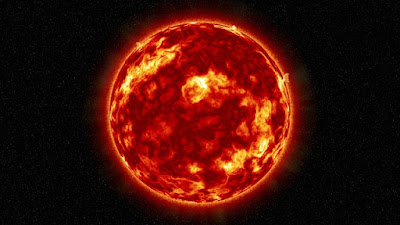
However, eventually, the Sun will become a red giant star
and will expand, engulfing the inner planets including Earth. It is likely that
the Earth will be destroyed during this process.
It is also possible that human actions could significantly
affect the future of the Earth. For example, if humans continue to contribute
to climate change through the emission of greenhouse gases, it is possible that
the Earth's climate could become less hospitable to life.