
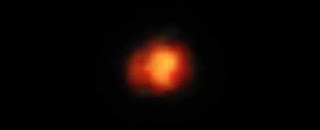
 |
| Maisie's Galaxy (Credit: NASA/STScl/CEERS/TACC/ University of Texas at Austin/S.Finkelstein/M.Bagley) |
According to a team led by astronomer Pablo Arrabal Haro of
the US National Science Foundation's NOIRLab,
the results not only help confirm the
early Universe is indeed way
more populated than we expected, but that care is needed in analyzing the
JWST observations.
"The exciting thing about Maisie's galaxy is that it
was one of the first distant galaxies identified by JWST, and of that set, it's
the first to actually be spectroscopically confirmed," Steven Finkelstein of the University of Texas at Austin,
who named the galaxy in honor of his daughter, on whose birthday the galaxy was discovered last year.
Identifying the timeframe of galaxies emerging in the early
Universe takes a bit of figuring out.
This results in the light becoming stretched, or redshifted;
its wavelengths become longer, attenuating out into the redder parts of the
spectrum. Using the letter z to describe this phenomenon, astronomers use
measures of redshift to work out the time the light was emitted.
JWST is a powerful instrument that studies the Universe in
these infrared wavelength. This is why scientists are using it to look deeper
into the early Universe than we've ever been able to before.
But there is more than one way to calculate z. When
Finkelstein and his team first published on Maisie's Galaxy, they based their redshift estimate on photometry; that
is, the brightness of the light seen through several filters. That work
returned an estimate of z~12. That means they thought the galaxy was observed
around 366 million years after the Big Bang.
To refine that result, the team followed up using the
JWST's spectroscopic instrument, NIRSpec,
which splits the light into different near-infrared wavelengths for a more
detailed analysis. And the NIRSpec data returned a redshift of z=11.4; around
390 million years after the Big Bang. This means that the light from Maisie's
Galaxy traveled for around 13.4 billion years before being picked up by JWST.
The research also looked at two other early Universe
galaxies picked up in the Cosmic Evolution Early Release Science (CEERS) Survey that gave us Maisie's Galaxy.
One of those returned a redshift consistent with its photometric estimate, with
a redshift of z=11.043; but the other was quite off.
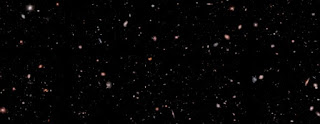 |
| The CEERS Field. These dots represent galaxies (F.Summers, G.Bacon, J.DePasquale, L.Hustak, J.Olmsted, A.Pagan/STScl) |
CEERS-93316 was
tentatively identified at 250 million years after the Big Bang - redshift z≃16.4 -
but spectroscopic follow-up was needed to confirm. And spectroscopic follow-up
got a very different redshift, just z=4.9. That's around 1.2 billion years
after the Big Bang.
The misidentification occurred because it had three
overlapping properties that mimicked the colors expected of a galaxy spotted at
z≈16 in photometric analysis.
Other galaxies could also fall into this "triple
overlap zone", the researchers say, requiring extra care for those objects
that appear to have particularly high redshifts.
But, all's well that ends well, as far as CEER-93316 is
concerned.
"It would have been really challenging to explain how
the Universe could create such a massive galaxy so soon," Finkelstein says.
"So, I think this was probably always the most likely
outcome, because it was so extreme, so bright, at such an apparent high
redshift."
The research has been published in Nature.