
Quantum Mechanics
Quantum mechanics is a branch of physics that deals with the
behavior of matter and energy at the microscopic level. It is a fundamental
theory that has revolutionized our understanding of the physical world,
challenging many of our classical notions about how the universe works.
At the heart of quantum mechanics is the concept of the
quantum, which refers to the smallest possible unit of energy. In contrast to
classical mechanics, which is based on the laws of motion and the conservation
of energy, quantum mechanics is based on the wave-particle duality of matter
and the uncertainty principle, which states that certain pairs of physical
properties, such as position and momentum, cannot both be precisely determined.
The development of quantum mechanics was a long and complex
process, involving many of the greatest minds of the 20th century, including
Niels Bohr, Werner Heisenberg, Erwin Schrödinger, and Richard Feynman. Despite
its theoretical complexity, quantum mechanics has found a wide range of
practical applications, from the design of new materials and drugs to the
development of quantum computers and cryptography.
In this article, we will explore some of the key concepts
and principles of quantum mechanics, including the Schrödinger equation, wave
functions, observables, and entanglement, and examine some of the ways in which
this revolutionary theory is transforming our understanding of the physical
world.
 |
| Pixabay |
The Schrödinger Equation and Wave Functions
The Schrödinger equation is the fundamental equation of
quantum mechanics. It describes how the wave function of a quantum system
evolves over time, given its initial state. The wave function is a mathematical
description of the quantum state of a particle, which encodes information about
its position, momentum, and other physical properties.
The Schrödinger equation is a partial differential equation
that can be used to calculate the probability distribution of a particle's
position or momentum at any point in time. The equation takes the form of a
time-dependent wave equation, and its solutions are known as wave functions.
The wave function provides a complete description of the particle's quantum
state, from which all other physical properties can be derived.
The wave function is a complex-valued function, meaning that it has both a real and an imaginary part. The magnitude of the wave function squared gives the probability density of finding the particle in a particular location, while the phase of the wave function determines the interference pattern of the wave.
Observables and Uncertainty
Principle
In quantum mechanics, observables are physical quantities
that can be measured, such as position, momentum, energy, and spin. However,
unlike in classical mechanics, the measurement of an observable in quantum
mechanics can alter the state of the system being measured.
The uncertainty principle is a fundamental concept in
quantum mechanics that states that there is a fundamental limit to the
precision with which certain pairs of observables can be simultaneously
measured. Specifically, the uncertainty principle states that the product of
the uncertainties in the measurements of position and momentum of a particle
cannot be smaller than a certain minimum value. This means that the more
precisely we know the position of a particle, the less precisely we can know
its momentum, and vice versa.
The uncertainty principle arises from the wave-particle duality of matter, which means that particles can exhibit wave-like behavior and interfere with each other. The act of measuring a particle's position or momentum disrupts its wave-like behavior, leading to uncertainty in the measurement of the other property.
Despite its limitations, the uncertainty principle has many
practical applications in quantum mechanics. It is used to calculate the
behavior of atoms and molecules, to design new materials with specific
properties, and to develop new quantum technologies such as quantum
cryptography and quantum computing.
Quantum Entanglement and
Superposition
Quantum entanglement and superposition are two of the most
fascinating and counterintuitive aspects of quantum mechanics.
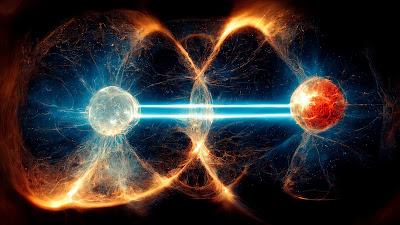
Quantum entanglement refers to a phenomenon in which two or
more particles become linked in such a way that the state of one particle is
dependent on the state of the other, regardless of the distance between them.
This means that if the state of one particle is measured, the state of the
other particle will be instantly determined, no matter how far apart they are.
 |
| Credit: Google |
Quantum superposition, on the other hand, refers to a state in which a particle exists in multiple states or locations simultaneously. In other words, a particle can be in two or more places at once, or have two or more different properties at the same time. This is in stark contrast to classical physics, where a particle can only be in one place at a time and can only have one property at a time.
The phenomenon of entanglement and superposition arise from the fact that quantum particles can exist as waves, rather than just particles, and that the wave functions of these particles can overlap and interfere with each other. This leads to the strange and seemingly paradoxical behavior of quantum systems, such as particles existing in two different states or locations at the same time or particles becoming entangled even though they are separated by vast distances.
Applications of Quantum
Mechanics
Quantum mechanics has many practical applications in various
fields, including:
- Computing:
Quantum mechanics has led to the development of quantum computers, which
have the potential to solve problems that are intractable for classical
computers. Quantum computers use quantum bits, or qubits, which can exist
in superposition and entanglement states, allowing for parallel processing
and faster computation.
- Cryptography:
Quantum mechanics has also led to the development of quantum cryptography,
which uses the principles of entanglement and superposition to create
secure communication channels that cannot be intercepted or tampered with.
- Materials
Science: Quantum mechanics is used to understand the properties of
materials at the atomic and molecular level, which has led to the
development of new materials with unique properties, such as
superconductors and nanomaterials.
- Energy:
Quantum mechanics is used to develop new technologies for energy production
and storage, such as quantum dot solar cells and quantum batteries.
- Medicine:
Quantum mechanics is used in medical imaging, such as magnetic resonance
imaging (MRI), which uses quantum principles to detect signals from atomic
nuclei in the body.
- Chemistry:
Quantum mechanics is used to understand the behavior of molecules and
chemical reactions, which has led to the development of new drugs and
materials.
- Astronomy:
Quantum mechanics is used to study the behavior of stars, black holes, and
other celestial objects, which has led to a better understanding of the
universe.
Overall, quantum mechanics has revolutionized our understanding of the physical world and has led to many practical applications that have the potential to transform our society in the future.