
The Origin & Development of the Big
Bang Theory
The Big Bang Theory is a scientific explanation for the
origin and evolution of the universe. It was first proposed in the early 20th
century by Georges Lemaitre, a Belgian astronomer and Catholic priest. Lemaitre
suggested that the universe began as a single point of infinite density and
temperature, which he called the "Primeval Atom."
The term "Big Bang" was coined by the British
astronomer Fred Hoyle in the 1940s, as a term of derision for the theory. Hoyle
preferred a steady state model of the universe, in which new matter was
continually created to maintain a constant density.
However, over time, the evidence in support of the Big Bang theory accumulated. In the 1960s, observations of the cosmic microwave background radiation provided strong evidence for the theory. The discovery of the cosmic microwave background radiation was made by Arno Penzias and Robert Wilson in 1964, for which they received the Nobel Prize in Physics in 1978.
Evidence Supporting the Big Bang Theory
There is a wide range of evidence supporting the Big Bang
theory, including:
- Cosmic
Microwave Background Radiation: In 1965, Arno Penzias and Robert Wilson
discovered a faint, uniform background radiation in the microwave spectrum
that permeates the entire universe. This radiation is thought to be the
leftover heat from the Big Bang, and its characteristics are consistent
with what would be expected from a hot, dense, expanding universe.
- Hubble's
Law: In the 1920s, Edwin Hubble discovered that the light from distant
galaxies was shifted towards the red end of the spectrum, which indicated
that they were moving away from us. This effect, known as redshift, is now
understood to be caused by the expansion of the universe.
- Abundance
of Light Elements: The Big Bang theory predicts that the early universe
was hot and dense enough to produce helium, lithium, and other light
elements. Observations of the abundance of these elements in the universe
are consistent with this prediction.
- Large
Scale Structure of the Universe: The distribution of galaxies and other
matter in the universe is consistent with the Big Bang theory. In
particular, the observed large-scale structure of the universe, including
the clustering of galaxies into groups and super
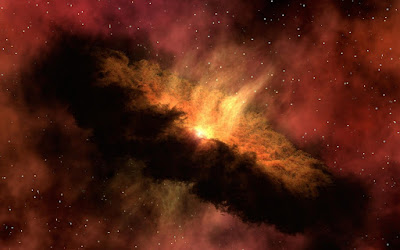
Pixabay
clusters, is thought to have arisen from small fluctuations in the density of matter in the early universe. - Time
Dilation of Supernovae: Observations of supernovae in distant galaxies
have revealed that they are dimmer than expected, which suggests that they
are farther away than would be predicted by a static, non-expanding
universe. Additionally, these observations indicate that the expansion of
the universe is accelerating, which is consistent with the presence of a
mysterious form of energy known as dark energy.
These and many other lines of evidence strongly support the
Big Bang theory and have helped to establish it as the leading explanation for the origin and
evolution of the universe.
Components of the Big Bang
Theory
The Big Bang theory is based on several key components,
which are:
- The
universe began as a singularity: The Big Bang theory posits that the
universe began as a singularity, a point of infinite density and
temperature, from which the universe expanded and cooled.
- Inflation:
The universe underwent a period of rapid expansion, known as inflation,
within the first fraction of a second after the Big Bang. This period of
inflation is thought to have smoothed out any irregularities in the early
universe and set the stage for the formation of galaxies and other
structures.
- Nucleo synthesis:
During the first few minutes after the Big Bang, the high temperatures and
densities allowed for the formation of light elements such as hydrogen,
helium, and lithium through a process known as nucleo synthesis.
- Cosmic
Microwave Background Radiation: As the universe cooled after the Big Bang,
it became transparent to radiation, and the leftover heat from the Big
Bang was released as cosmic microwave background radiation (CMBR). The
CMBR provides a snapshot of the early universe and is a crucial piece of
evidence supporting the Big Bang theory.
- Large
Scale Structure Formation: Over time, the gravitational attraction between
matter caused it to clump together and form galaxies, clusters of
galaxies, and other structures. This process of large-scale structure
formation is thought to have been driven by the tiny fluctuations in the
density of matter present in the early universe.
These key components of the Big Bang theory are supported by
a vast amount of observational evidence and have helped to establish the theory
as the most widely accepted explanation for the origin and evolution of the
universe
Controversies and Criticisms
Surrounding the Big Bang Theory
Although the Big Bang theory is widely accepted as the best
explanation for the origin and evolution of the universe, there are still some
controversies and criticisms surrounding it. Here are some of the main ones:
- The
Horizon Problem: The universe appears to be homogeneous and isotropic on
large scales, yet different regions of the universe are too far apart to
have ever been in causal contact. This is known as the horizon problem,
and it is difficult to explain within the framework of the Big Bang
theory.
- The
Flatness Problem: The observed density of the universe appears to be very
close to the critical density required for the universe to be flat, yet
the early universe should have had a much greater curvature. This is known
as the flatness problem, and it requires the early universe to have been
fine-tuned in a way that is difficult to explain.
- The
Missing Antimatter Problem: The Big Bang theory predicts that equal
amounts of matter and antimatter should have been produced in the early
universe, yet the observable universe appears to be made almost entirely
of matter. This is known as the missing antimatter problem, and it is
still not fully understood.
- Dark
Matter and Dark Energy: The Big Bang theory requires the existence of dark
matter and dark energy, which are forms of matter and energy that do not
interact with light and have yet to be directly observed. This has led to
some criticism that the Big Bang theory relies too heavily on unproven
hypotheses.
- Alternative
Theories: There are alternative theories to the Big Bang, such as the
steady state theory and the cyclic model, which propose different
explanations for the origin and evolution of the universe. While these
theories have been largely discredited by observational evidence, they
still have some adherents who dispute the Big Bang theory.
These controversies and criticisms highlight the ongoing nature of scientific inquiry and the need for continued research and investigation to refine and improve our understanding of the universe