
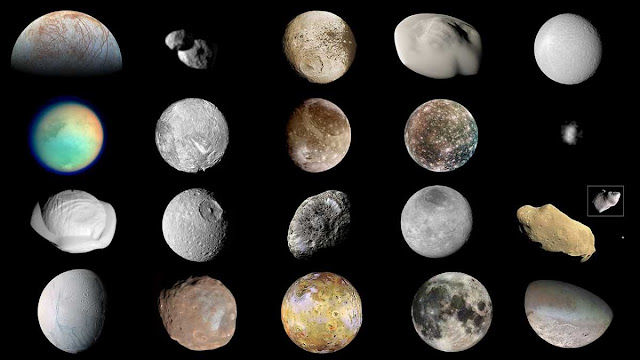
A moon of a planet in our solar system is a natural satellite that orbits a planet. Each planet in our solar system has one or more moons, with a total of over 200 moons in the solar system. Moons come in a variety of sizes, from tiny moonlets to large moons that are nearly as big as the planet they orbit. The moons of our solar system have diverse geological features, such as craters, mountains, valleys, and vast plains. Some moons have atmospheres, while others are heavily cratered and have no atmosphere.
 |
| Credit: Google Images |
Formation Of Moons Of Solar System
Moons, or natural satellites, are celestial bodies that
orbit planets and other celestial objects. Moons form in a variety of ways, and
the exact process depends on the specific conditions in the solar system where
they formed.
One common theory is that moons form from the debris left
over after a planet forms. As a planet grows, it can capture material from the
surrounding disk of gas and dust, and this material can eventually clump
together to form moons. e.g. Galilean Moons (Europa, Ganymede & Callisto) are thought to have formed from the same disk of material which formed Jupiter.
Another theory is that moons can form from collisions
between planets or other large celestial objects. In this scenario, a large
impact can cause material to be ejected from the surface of a planet, and this
material can then come together to form a moon. e.g. Earth's Moon
In some cases, moons may also be captured objects that were formed elsewhere in the solar system and were later captured by a planet. For example, the Kuiper Belt, which is a region of the solar system beyond the orbit of Neptune, is believed to be the source of many of the moons in our solar system.
Planetary Moons
The solar system is home to numerous moons, or natural
satellites, which orbit around the various planets. The number of moons varies
greatly from planet to planet, with some having no moons at all and others
having over 80. The following is a detailed overview of the moons of our solar
system:
- Mercury : Mercury does not have any moons.
- Venus : Venus does not have any moons.
- Earth : Earth has one moon, which is known simply as " The Moon." The
Moon is the fifth largest moon in the solar system and is the largest
relative to the size of its host planet. It has a diameter of 3,476 km and
is the only moon in the solar system that is known to support human life.
The Moon is believed to have formed around 4.5 billion years ago from
debris left over after a massive impact between Earth and a Mars-sized
object.
- Mars : Mars has two small moons, Phobos and Deimos. Phobos is the larger of the
two, with a diameter of 22.2 km, while Deimos is much smaller, with a
diameter of just 12.4 km. Both moons are irregularly shaped and are
believed to be captured asteroids.
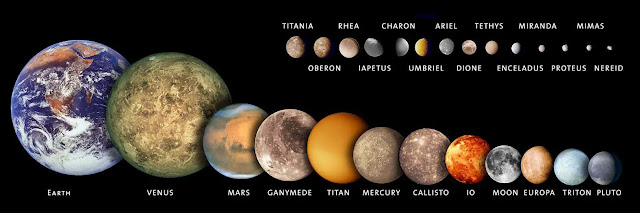
- Jupiter : Jupiter has 92 known moons, the largest number of any planet in the
solar system. The four largest moons, known as the Galilean moons, are Io,
Europa, Ganymede, and Callisto. Europa is covered in a thick layer of ice and is
believed to have a subsurface ocean. Ganymede is the largest moon in the
solar system and is the only moon known to have a magnetic field. Callisto
is the most heavily cratered body in the solar system.
- Saturn : Saturn has 83 known moons, the second largest number of any planet in
the solar system. The largest of these moons is Titan, which is larger
than the planet Mercury and has a dense atmosphere and a surface dotted
with lakes of liquid hydrocarbons. Other notable moons of Saturn include
Enceladus, which is known for its geysers of water vapor and ice, and
Iapetus, which has a heavily cratered and a bright, icy surface.
- Uranus : Uranus has 27 known moons, the third largest number of any planet in the
solar system. The largest of these moons is Titania, with a diameter of
1,578 km. Other notable moons of Uranus include Oberon, which is heavily
cratered and has a bright, icy surface, and Miranda, which has one of the
most varied and unusual surfaces of any moon in the solar system.
- Neptune : Neptune has 14 known moons, the fourth largest number of any planet in
the solar system. The largest of these moons is Triton, which is the
largest moon relative to the size of its host planet. Triton is also known for its geysers of nitrogen gas,
which are the only such geysers known in the solar system.
In addition to the moons of the eight planets, the solar
system also contains many smaller moons, such as the asteroids and dwarf
planets, which are believed to have formed from the same material as the rest
of the solar system. These moons are often irregular in shape and are believed
to be the remnants of early solar system bodies that were unable to accrete
into full-fledged planets.
 |
| Credit: Google Images |
Prominent Moons
There are many moons in our Solar System, but some of the
most important and interesting ones include:
- The
Moon: Our Moon is the largest moon relative to the size of its planet and
is the fifth largest moon in the Solar System. It has a significant impact
on Earth's tides, stabilizes the planet's axial tilt, and has played an
important role in the evolution of life on our planet.
- Io: Io
is one of the Galilean moons of Jupiter and is the most volcanic moon in
the Solar System. Its surface is constantly being reshaped by volcanic
eruptions, making it one of the most unique and interesting moons in our
Solar System.
- Europa: Europa is another one of the Galilean moons of Jupiter and is believed to
have a subsurface ocean of liquid water, making it one of the most
promising places in our Solar System to search for extraterrestrial life.
- Titan: Titan is the largest moon of Saturn and is the only moon in the Solar
System with a significant atmosphere. Its atmosphere is primarily composed
of nitrogen, and it also contains large lakes and seas of liquid methane
and ethane, making it a unique and intriguing place to study.
- Triton: Triton is the largest moon of Neptune and is one of the few moons in the
Solar System that orbits its planet in the opposite direction of its
planet's rotation. It is also one of the coldest objects in the Solar
System, with surface temperatures reaching as low as -235°C.
These are just a few of the many moons in our Solar System that are of scientific interest and have helped us better understand the evolution and dynamics of our Solar System.