
 |
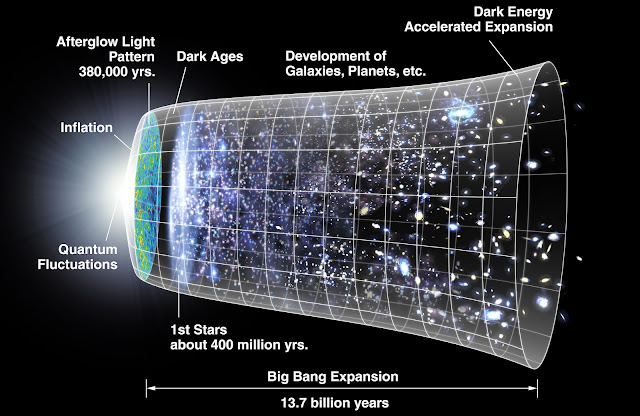
| Credit: NASA/JPL |
Proponents Of Big Bang Theory
Lemaitre's proposal was met with skepticism at first, but it
gained acceptance in the scientific community over time, and was later
developed into the modern Big Bang theory by other scientists such as Edwin
Hubble, George Gamow, and Robert Dicke.
Evidence Of Big Bang Theory
The Big Bang theory is the prevailing cosmological model
that explains the origins and evolution of the universe.
1) Redshift of Light from Distant Galaxies
One of the key predictions of the Big Bang theory is that
the universe should be expanding. This prediction was confirmed in the 1920s by
Edwin Hubble's observations of galaxies moving away from each other, which
indicated that the universe was expanding.
2) Cosmic Microwave Background Radiation
The Big Bang theory also predicts that the universe should
have a specific pattern of temperature variations, known as the cosmic
microwave background radiation. This radiation is a faint glow that fills the
universe and is believed to be the afterglow of the Big Bang. Its discovery in
1964 provided strong evidence in favor of the Big Bang theory and against the
steady state theory.
3) Abundance of Light Elements
The Big Bang theory also predicts that the
universe should have a specific abundance of light elements such as hydrogen,
helium, and lithium. This prediction was confirmed by observations of the
cosmic microwave background radiation and the abundance of these elements in
the universe.
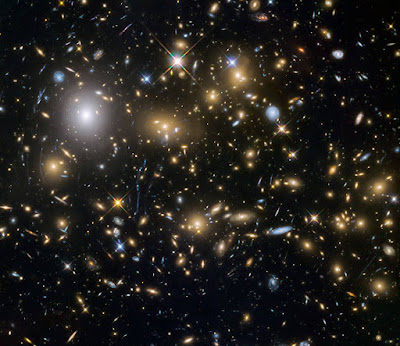
4) Large-scale Structure of the Universe
The Big Bang theory also predicts that the universe should
have a specific large scale structure, including galaxy clusters and large
scale homogeneity and isotropy which have been observed and confirmed by
astronomical observations, supporting the theory.
As the universe expanded and cooled, it is believed that
subatomic particles combined to form atoms, which then combined to form stars
and galaxies. Over time, these stars and galaxies have continued to evolve,
forming new stars and galaxies through processes such as stellar
nucleosynthesis, supernovae and galaxy mergers.
5) Gravitational Effects of Dark Matter and Dark Energy
The Big Bang theory also suggests that the universe should
be filled with dark matter and dark energy, which are mysterious forms of
matter and energy that do not interact with light and cannot be directly
observed. These forms of matter and energy are thought to make up approximately
95% of the universe's total mass-energy content and are responsible for the
accelerating expansion of the universe..
 |
| Credit: NASA/ Hubble |
The Big Bang theory is also supported by a wide range of scientific disciplines, including astronomy, cosmology, particle physics, and theoretical physics. It has been tested extensively through a variety of observations and experiments, and has been found to be in agreement with a wide range of data.
Overall, the Big Bang theory is a well-established and widely accepted model of the universe's origins and evolution. It successfully explains a wide range of observed phenomena and is supported by a wealth of observational evidence. While some aspects of the theory, such as the nature of dark matter and dark energy, remain mysterious, it remains the foundation of modern cosmology and continues to shape our understanding of the universe.